Toe length…
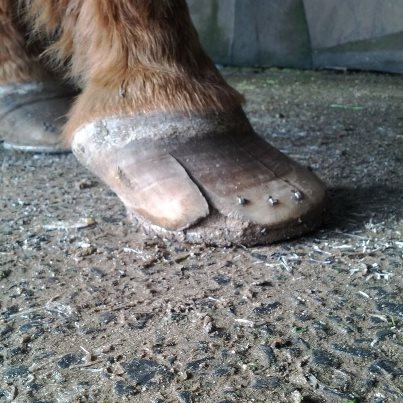
Thoroughbred with long toes. There is no doubt this horse would have some degree of lameness, probably forges. Note the crack in the hoof, caused by long toes.
Probably the singularly most overlooked cause of hoof problems in the equine world. And ironically, the absolute most important factor. If horses had correct toe length, there is no doubt in my mind that 95% the lameness issues the average horse owner dealt with – wouldn’t exist.
Lets have a look:
- Toe Cracks
- Wall Cracks
- Forging
- Stumbling
- Chronic Lameness

This horse, rim shod with long toes – image from http://farrieritis.care4horses.com/2007/09/21/long-toe-syndrome-recognizing-problems-before-its-too-late.aspx
And these are just the manifestations of long toes in the FOOT! You then have to deal with the manifestations within the body / mind
- No topline
- Grumpy / Aggressive horse
- Constant back soreness or “saddlefit issues”
- Horse that rushes on trails
So lets talk about these issues, how and why they are cause & effect of long toes:
Toe Cracks
You’ve probably been told that toe cracks are due to the fact that your horse has “bad feet” or “bad breeding”, some farriers might have even told you its because of your horses breed: “Its a thoroughbred, not much you can do really”.
But that’s not really true. Toe Cracks are the consequence of incorrect shoeing / trimming. Try this experiment: Using the longest fingernail you have, flick it repeatedly over the edge of a benchtop or similar flat object with a sharp edge. Do this for 30 seconds. How long do you think it will take before you fingernail starts to tear, chip and bleed.
What you are experiencing is a “lever moment” (as the engineers among us would say), Where the effect at the attachment point is magnified incredibly, due to the distance from attachment point to the application of the force.
In English, this means, the longer the toe, the worse the “reaction” at the attachment point.. the attachment point being – the hoof wall. The hoof wall, is the weakest attatchement point, and WILL CRACK because of the leverage caused by long toes.
Forging
Or the action of the horses back foot interfering with the front – usually meaning the horse clips the heels of his front feet, with his back feet – again – due to the fact that the horses feet are too long. Do you remember when you were young, at the beach, or the pool, running in flippers? Or, trying to run in flippers. Never a very successful exercise was it..
Forging is no different – the horses natural action is being interfered with by its long toes. These horses are labelled lazy, or clumsy – but they aren’t – they are trying to walk with toes that interfere with their natural movement, this of course, leads us to..
Stumbling:
A horse who forges, or stumbles in a walk / trot etc, is often accused of being lazy or clumsy. Again, this is usually not the horses fault. Using the flipper analogy again, do you remember how hard it was to run in flippers? Why should it be any easier for your horse? Horses with long toes, run in flippers every day! This of course leads us to..
Chronic Lameness
And can you blame the horse? A horse with long toes is probably using muscles he never even knew existed, in order to “get over” his long toes. Horses that chonically pull up sore after a ride are not athleticising correctly, and the issue more often than not, starts in the foot, His natural action is exaggerated to compensate for the toes, he’s using way to many muscles to do the simplest of gaits, and expending way to much energy, of course he is going to be sore.
So, then, lets take a look at the associated issues of excessive toe length in a horse: No topline, grumpy / aggressive horse / backsoreness / horse that rushes.
These can all be attributed to consequences of foot pain.
The horse that “braces” in order to cope with pain in his feet, will have back pain which most people mistake for saddlesoreness. Its usually due to the feet. A horse who braces against pain cannot develop topline, because he isn’t using his topline muscles! This creates a sore horse, who isn’t resting well of a night because he can’t achieve an optimum resting stance due to his long toes. The horse is now not sleeping well, and is beginning to associate riding or groundwork with pain in his feet – Of course he is going to be grumpy or saddle aggressive. Finally, you might even find your horse rushes out on the trails. Why? Because he’s not stupid. Firstly, the quicker he moves, the quicker he gets home and the pain stops. And secondly, the quicker he moves, the quicker the pain caused by excess leverage acting at the hoof wall – is transferred from one foot to the other.
There is nothing on the bottom of a horses foot that wasn’t designed to bare weight
I’ll say it again.
There is nothing on the bottom of a horses foot, that isn’t designed to bare weight.
Was the hoof wall ever meant to take the full load of a 500kg horse at full speed? No.
Was the frog ever meant to take the full load of a 500kg horse at full speed? No.
What about the sole? No!
But were these three separate elements designed to take the SHARED load of a 500kg horse at full speed? Absolutely!
The hoof “UNIT”, takes the reactive force of a horse moving at speed over ground, and shares it over the entire hoof mechanism. Read again “mechanism”. Each individual element acts together in order to disperse that massive load, evenly over the entire foot and up the leg, into the larger musculoskeletal system.
And what do we do?
We load the peripheral edge of the wall…. keep the toes long to tack a rim shoe on, which serves NO purpose but to weaken the integrity of the toe to laminae attachment, by forcing the full load a horse in movement, to be absorbed purely by the long toes!
If you take nothing else away from this blogpost, remember this one thing: Length creates leverage. This is a simply rule of statics / physics, which doesn’t change just because it involves horses.
Length creates leverage. The longer the toes, the more leverage.
Its as simple as that.
 Cytek shoes Revolution