As someone who has experienced “corrective shoeing” first hand, and witnessed other horses endure other variations on the theme, I thought it might be a good idea to talk about corrective shoeing.
Basically, the term corrective shoeing refers to any form of shoeing done to a horse in order to fix a particular problem / issue. (your usual band of suspects include laminitic horses, lame horses and pigeon toed horses).
I want to look at the last two – lame and pigeon toed horses. Only because, its in interesting study. Is the horse lame because its correctively shod, or correctively shod because its lame?
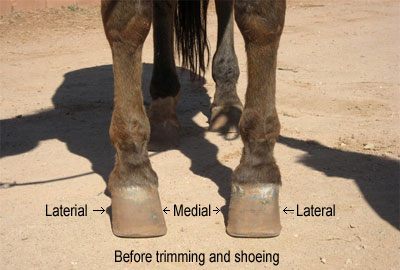
Pigeon toed horse with extremely long toes (image borrowed from here
A pigeon toed, or a “toed in” horse, has front feet (or back feet) that “point in”. You could get a horse like mine who’s front feet “toe in” and who’s back feet “toe out” but, he’s pretty special 😉
Now, when it comes to correctively shoeing the pigeon toed horse – the farrier’s sole purpose is getting the feet straight. For what reason, is beyond me – when my own horse was correctively shod – he wasn’t actually lame, so why he needed “correcting” is a mystery.
See, you can’t “fix” pigeon toed. You can’t correctively shoe it, it doesn’t “grow out”.
Think about it. The bones are set, the horse is full grown, any correction to the horses conformation needed to be done within the first few weeks of its life.
What happens is, the farrier comes out, and in an effort to get the horses feet cosmetically straight to look at, (this fixes the feet apparently), he lets one side of the hoof grow longer than the other as well as letting the toe grow long, after a few shoeings, the foot may start to look a little straighter and the owner might think this corrective shoeing is working, but what is happening on the inside of the foot? Up until the horse had been correctively shod, the bones were parallel to the ground, albeit they pointed “in” not straight. But, with this new corrective shoeing, the bones are now no longer parallel to the ground. They’re jacked up on one side, with the full force of the horses weight bearing down on one side of the bone, the reaction in the foot being compounded by the excessive length of the toe. Straight as an arrow on the outside, crooked as a dogs hind leg on the inside – the horse now starts to show signs of lameness, unwillingness to pick up transitions, or maintain gait, he starts to get lethargic, lame, depressed, angry even.
What happens now? The owner gets worried and calls a vet, the vet comes out and starts throwing around terms like “Osteo-pedal arthritis or “Degenerative pedal bone disease” and other terrifying names. Options such as nerve blocks and the like are thrown around, before the vet eventually concedes the horse probably needs humanely euthanising because it has bad feet (probably blaming genetics)
But fundamentally – the problem is, the horse is not balanced. His bones are now tilted at an angle he can’t bear – He’s in agony, thanks to corrective shoeing.
What can you do for the pigeon toed horse?
The awesome thing is – it’s so easy! – let him be pigeon toed. It’s not going to kill him, its not the cause of his lameness, its not going to loose you marks in the show ring. You can’t force the hoof to be something its not. Leave him as nature intended That is, with a short toe, and pedal bone parallel to the ground, its not going to cure the pigeon toe, but the short toe will make it appear less noticeable My horse has been Cytek shod for two years. A short toe and sole support have done wonders for him. In two years he has NEVER been lame. Not even remotely tender. He has never fallen over, he has never tripped over his own feet, and he is to this day classed as a pigeon toed horse. We are now both learning basic dressage moves, something he handles with ease as a pigeon toed horse.
The only corrective shoeing you need is correct shoeing. A short toe, and sole support.
If you know someone who would benefit from this article – send it on.
 Cytek shoes Revolution
BRILLIANT !!!!!!! Thank you thank you thank you.
Howdy! I just wish to give you a big thumbs up for your great information you have here on this
post. I will be coming back to your website for more soon.