
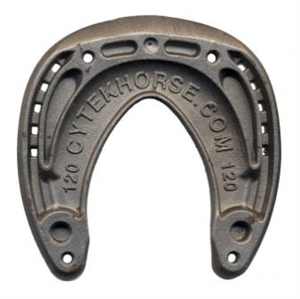
Today, i want to look at the fundamental differences between a Cytek shoe, versus a rim shoe.

A Standard rim shoe
Take a few minutes to look at both images. Have a look at the width of the shoe, take notice of the amount of metal used in each shoe.
At a glance – which shoe do you think gives more support? The Cytek, or the rim shoe?
The first introduction I ever had to cytek shoes was when my soon to be farrier threw one on the ground infront of me, along with a rim shoe, and directed me to put my left foot on one, and right foot on the other.
Wow.
Have you ever done that? If so – we probably have the same farrier 🙂 But seriously, I thoroughly recommend this for ANYONE who gets the opportunity to do it. put one foot on a cytek, and the other on a rim shoe. Feel what your horses feel.
Your foot will fall through the bottom of the rim shoe, whereas your foot will feel more stable in a cytek shoe. Its something that you won’t get until you experience it.
What has a Cytek shoe got, that a rim shoe doesn’t?
Put simply?
Sole support.
The Cytek shoe takes a foot with a balanced trim and short toe, and gives it support. There is nothing magical about these shoes. They are not therapudic, they are not remedial, they are not corrective (don’t get me started on corrective shoeing), they are common sense shoeing, the way it used to be done. Get the toe back, support the foot. Its that simple.
What is the major difference between a Cytek shoe and a rim shoe?
The distribution of load.
The Cytek shoe (owing to its width and placement on the foot) takes the reactive load of a horse in movement, and distributes it evenly over the foot, and subsequently through the skeletal system of the horse.
A Rim shoe, (owing to its lack of width and placement on the foot), takes the reactive load of a horse in movement and channels it all on the wall of the horse. Go back and have a look at the two images. Can you see it now? A rim shoe works on the fallacy that the wall was designed to take the full load of the horse. As discussed in my earlier post, this is not true. There is nothing on the bottom of a horses foot that wasn’t designed to take load. Once you can get your head around that concept – seeing the fundamental differences in the loading principles of each shoe is pretty obvious, don’t you think?
The rim shoe loads the wall.
The Cytek shoe, loads the foot.
Why is the placement of the shoe so important?
The Rim shoe, is designed to fit to the wall of the horses foot, because of the design of the shoe, the constraints on where it is attached, a great deal of wall length is required in order for the shoe to be fitted correctly. As we now know – length creates leverage. The more length, the more leverage!
The Cytek shoe is designed to locate under the pedal bone (sole support), as such it sits back further on the foot, breakover is bought back, making the horses gaits smoother, and more efficient, the pedal bone is supported – taking away any pain caused by previous lack of support.
But, don’t they both nail through the wall?
Yes, both shoes do. However, its the size / design of the shoe that denotes distribution of load, not where the shoe is nailed. The bigger the surface area of the shoe, the bigger the distribution of load.
How long have Cytek’s / Rim shoes been around?
Now, this will shock you. Most people regard Cytek shoes as “new” technology. But its not. Rim shoes are the new technology.
A simple google search of “horse shoes” leads us here:
You don’t have to read the article if you don’t want to – just look at the pictures! Have a look at the size of those shoes! Look familiar?? Cytek’s are so old, they’re new again. Cytek’s, in one form or another, have been around since the earliest records of horse shoeing. Rim shoes exist as a cost cutting exercise – It cost far less both in man power and monetary terms to churn out rim shoes, than the comparative cytek’s. Take a look at the first two images on this post. Which do you think is harder to produce? Which has the more metal? How many horses shod in the days of the above article experienced laminitis? Navicular, ringbone? This very concept is a separate blogpost all of its own!
For now – if you know someone who would benefit from this article – send it on
Interesting reading wouldn’t you agree?
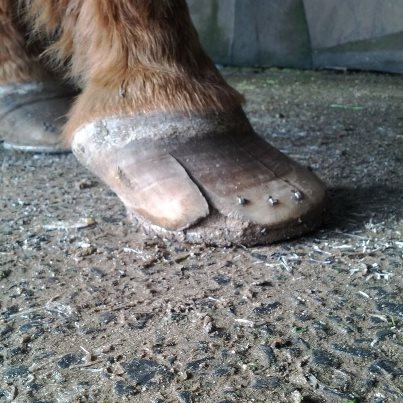

 Cytek shoes Revolution